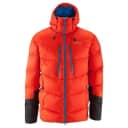
Production of winter sleeping bags with proper thermal insulation in Tabriz is based on the use of processed feathers with fill power above 700 and sewing patterns without thermal bridges. In the mountainous climate of Azerbaijan and the country's cold roads, maintaining a comfortable temperature up to minus 25 degrees Celsius can only be achieved by carefully controlling the density of feathers and windproof breathable fabrics. Par Jadhari, as a specialized unit for manufacturing mountaineering heating equipment, has implemented this technical cycle from optimization of the channels holding the per to field tests in the heights of Sablan and Sahand.
Heat transfer challenges and winter sleeping bag manufacturing standards
Production of tools for survival in the cold first of all requires an understanding of the physics of thermal conduction and convection. In technical winter skis, a major part of the mountaineer's thermal energy loss occurs through the compression of the underlying insulation due to the weight of the body, as well as the penetration of environmental moisture into the middle layers. The international standard ISO 23537 categorizes sleeping bag temperature in three levels: Comfort, Limit, and Survival; However, in the dry and ultra-cold environments of the mountainous regions of Iran, reaching the actual limit temperature requires measures that cannot be answered by the fixed European laboratory tests alone.
While sleeping, the body releases an average of 200 to 500 ml of water vapor. If the insulating layer cannot direct this moisture out, the wet natural feathers lose their compressibility and are destroyed in a point form. Therefore, the coordination between the rate of steam release and the confinement of static air bubbles within the insulation fabric forms the main foundation of the design of the high-altitude sleeping bag in the multi-walled complex.
Formulation of thermal insulation: experimental comparison of natural goose down and synthetic fibers
The natural feathers of birds such as geese have the best ratio of heating to weight in nature due to their three-dimensional cluster structure. Fill Power Index reflects the ability of each ounce of fill to fill a certain volume of space in cubic inches. In heavy alpine climbs, every extra gram of weight in the pack means more oxygen and energy consumption by the climber; For this reason, insulations filled with 750 to 850 fill power create exceptional swelling and return to the initial volume.
On the other hand, silicone synthetic fibers have a better resistance to water absorption and maintain an acceptable part of their thermal power even in 100% humidity conditions, but in terms of weight and compression volume, they cannot compete with high-quality feathers. In the full-wall production workshops in Tabriz, by implementing the hydrophobic process (nano waterproof coating on the feather clusters), the weakness of moisture absorption has been curbed to about 90%, so that the sleeping bag does not lose thickness even after several consecutive nights in tents covered with ice crystals.
Importance of feather purity index
In professional sleeping bags, using a combination of at least 90% down and 10% feather is a technical requirement. Although the presence of a feather stem is cheaper, it causes holes in the fabric and increases the dead weight of the product without any useful heating efficiency.
Baffle architecture and seam engineering without thermal bridge
The biggest common mistake in making cheap sleeping bags is to use a simple stitch-through. In this way, the sewing line connects the outer layer directly to the inner layer, and along these lines, the thickness of the insulation reaches zero; A phenomenon called "cold thermal bridge" in heat transfer engineering.
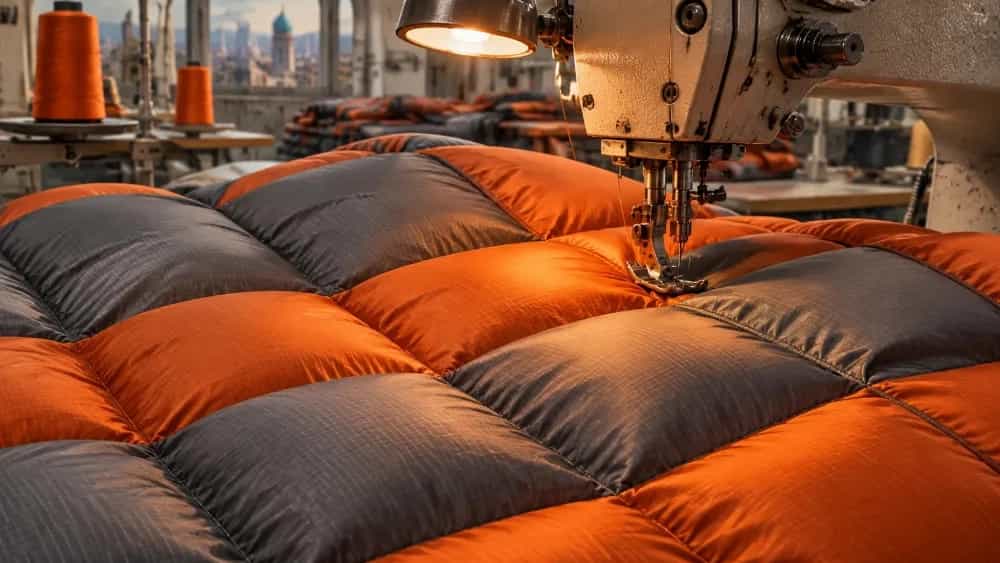
In advanced industrial manufacturing lines, box baffle design or trapezoidal baffles are used. In this architecture, mesh and very light walls are sewn between the inner and outer shell to create a cubic space for feather movement and air confinement. This method ensures that the thickness of the insulation remains completely uniform along the entire length of the body and that the cold flow of the surrounding environment does not penetrate through the seam lines. In addition, the design of the anatomical cap and thermal collar (Draft Collar) prevents the leakage of respiratory heat and trapped air in the chest area to the outside.
Selection of specialized anti-tear fabrics and moisture management system
Sleeping bag protective shells must strike a delicate balance between rock abrasion resistance, wind impermeability and breathability. The use of nylon fabrics with ripstop texture in grams of 20 to 30 dinars provides high tensile strength without unnecessary weight increase.
DWR (Durable Water Repellent) coatings on the outer layer prevent the penetration of water droplets caused by morning dew or contact of the body with the wet wall of the tent, while the inner layer should have a soft and skin-friendly texture and disperse surface perspiration quickly. In addition to the fabric, the quality of the double-sided large-tooth zippers equipped with anti-stick tape plays an essential role in the sleeping bag's efficiency; Because the constant sticking of the zip to the edges of the thin fabric at minus twenty degrees can create very dangerous conditions for the climber.
Local advantages of production in Tabriz: supply chain and field monitoring
Tabriz has long been one of the powerful poles of textile, leather shoes and technical equipment in the Middle East region. This historical infrastructure has provided a significant advantage in access to advanced sewing machines, supply of sustainable textile materials and technical know-how of skilled craftsmen. From an economic point of view, local production in Tabriz deducts the heavy costs of customs tariffs, the exponential exchange rate and international transportation of European brand equipment from the final price and provides a tool at the level of world standards at a fair price to the mountaineering community.
In addition to the supply chain, the geographical location of Tabriz and its proximity to the rugged mountains of northwestern Iran has created a privileged base for continuous field testing. Before reaching the stage of industrial production, the prototypes designed by Parjadari are tested in harsh weather conditions and severe storms in the highlands of the region to ensure that the data on the temperature label are real, repeatable and guarantee the user's life in emergency situations.
Technical index | Processed goose down 90/10 (walled down) | Duck down 80/20 standard | Compressed synthetic fibers (microfiber) |
Fill Power | 750 to 850 cubic inches | 550 to 650 inches Cube | No index (equivalent to ~500) |
Heat to weight ratio | Ultra high (lightest state) | Moderate to high | Moderate to heavy |
Operating comfort temperature | Nu10 to minus 25 degrees Celsius | 0 to minus 10 degrees Celsius | zero to minus 5 degrees Celsius |
compressed volume in the backpack | very small (packability) high) | low to medium | high (bulky) |
moisture resistance | high (with coating Hydrophobic) | Medium (requires constant care) | Inherent and very high |
Insulation useful life | 8 to 12 years (with basic maintenance) | 4 to 6 years | 2 to 4 years (suffering from thickness loss) |