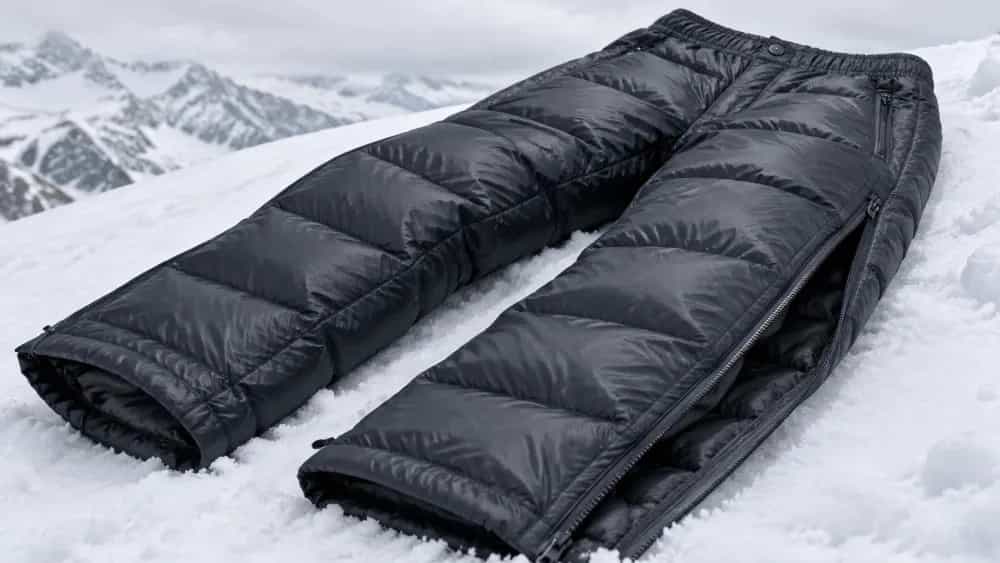
Production of lightweight and warm mountaineering pants requires a precise combination of tear-resistant micro-ripstop fabrics and goose down insulation with high fill power (at least 750 to 850) to achieve maximum warmth-to-weight ratio in sub-zero temperatures without increasing additional volume. This engineered product provides thermal performance by entrapping static air bubbles within the feather clusters, allowing it to be compressed into a backpack without damaging the insulating fabric. In the industrial production of this technical garment, the sealing of the seams and the use of double-sided side zippers maximize operational efficiency in snow camps and speed climbs.
Insulation engineering standards in the production of full climbing pants
The real warmth of the pants has nothing to do with the bulky thickness or heaviness of the clothes; Rather, it depends exactly on the index of swelling power or Fill Power. When one ounce of natural goose down fills a volume of 800 cubic inches, it provides the same thermal efficiency with one-third the weight of synthetic fibers. In multi-walled mountaineering heating equipment, we have seen many times in the laboratory test stages that using duck feathers instead of goose or reducing the purity of the filling from the ratio of 10/90 to 20/80 increases the final weight of the clothing by 25% for the same heating rate, and also significantly reduces the compression speed in the carrying bag.
Another essential point is the waterproofing of the feather clusters (Hydrophobic Down) in the production process. Raw feathers condense when exposed to body sweat or snow moisture and completely lose their thermal bridges. The impregnation of the fibers with waterproof nano polymer coatings makes the fill maintain its puffiness and not lose heat even after hours of walking in the blizzard and sleet conditions of the valley.
Choose between hydrophobic goose down and synthetic fibers
Although synthetic fibers have better structural resistance in wet conditions, no synthetic fiber can compete with the compression, durability and high-quality lightness of Himalayan climbing and alpine climbing. Engineered feather pants with waterproof nano coating are the best option for bitote on windy slopes and resting inside the tent.
Pattern architecture and windproof sewing systems and feather exit
The biggest problem in the production of mountaineering pants is the thermal bridge resulting from the normal stitching (Stitch-Through) and the phenomenon of the filling exiting through the needle holes. The direct all-over sewing brings the fibers to zero thickness in the seam line and causes the direct penetration of Suzbad Mountain to the surface of the thigh and knee muscles.
To solve this challenge, Box-Wall Construction is the main standard for the production of multi-walled specialized clothing. In this way, net walls made of light mesh are inserted between the outer layer and the inner layer so that the clusters have a three-dimensional and uniform space throughout the pants to expand the volume. The use of self-sealing polyester threads and ultra-thin needles with ballpoint tips prevents damage to the fabric and prevents the phenomenon of covering the seams.
Selection of upper textiles; A balance between minimal weight and mechanical durability
Using thick fabrics increases wear resistance but destroys the philosophy of light pants. Conversely, extremely light 10 denier fabrics will tear at first contact with rock and ice. The standard formula in multi-walled climbing heating equipment is combined stitching with a Body Mapping approach:
- Main body: Polyamide or nylon ripstop with a density of 15 to 20 denier equipped with a breathable DWR coating.
- High pressure areas (knees and seat): Cordura nylon or ripstop reinforced with 40 denier abrasion resistance for durability against ice breaker (crampons), ice and friction. Stone.
- Inner lining layer: Antimicrobial and moisture absorbent fabric without sticking to the wool base layer (Base Layer) so that the range of motion of the climber is not limited when walking in deep snow.
Ergonomic details and technical fittings for stormy conditions
Full pants are not a tool that a hiker can walk with all day, but are often worn over trekking pants when reaching a shelter, setting up camp, or experiencing a sudden drop in temperature. In such a situation, it is not wise and safe to take off heavy shoes or crampons to wear pants.
Accordingly, full-length zippers on both sides of the legs with windproof insulation behind the zipper are required. The design of the elastic belt without hard protrusions to avoid interference with the climbing harness, the wrists with the gaiter ability to block the way of snow and the installation of sewn knees with an ergonomic curve, transforms the movement performance from a comfortable camping pants to a defensive shield at high altitudes.
Local challenges of full pant production in Iran and implementation solutions
Production of specialized down clothing in the Iranian market is struggling with two major bottlenecks: provision of sanitary down with real down power and access to completely Down-Proof breathable fabrics. In practice, it has been observed that most of the various feathers in the market contain heavy stems and dust, which quickly smell damp and spoil after washing.
In order to solve this problem, we have implemented air sorting cycle and industrial washing with antibacterial solutions in order to solve this problem. Also, testing the impermeability of the fabrics under the pressure of humid air before entering the cutting line guarantees that environmental moisture will not enter the core of the pants and the product will not suffer structural quality loss during the multi-day ascents of Zagros and Alborz.
Technical parameters | Specialized height padded pants (baffle model) | Trekking heavy fiber pants | Padded pants Ultralight camping |
Thermal insulation type | 850FP hydrophobic goose down | Holofiber polyester | Combined duck and goose down 700FP |
Approximate total weight | 420 to 480 grams | 750 to 950 grams | 280 to 350 grams |
optimal temperature range | minus 15 to minus 35 degrees | zero to minus 10 degrees | Positive 5 to minus 10 degrees |
Compressed volume in the bag | 1.8 liters | 4.5 liters | 1.2 liters |
Sewing compartment structure | Box-Wall baffle | No compartment / bed | Direct all-over stitching |
Zipper access system | Two-way waterproof full length zipper | Above knee zipper | Without full zip (elastic) |
Reinforcement of knee and seat | Has (scratch-resistant nylon) | No / few | none |